
TL;DR
- India offers three main outsourcing models: Contractual agencies, Dedicated offshore teams via EOR, and Global Capability Centers (GCC)
- Contractual model: Fast start, low commitment, best for MVPs and short-term projects
- Offshore teams via EOR: High control without entity setup, ideal for product teams. Most in-demand roles deployed within 48 hours
- GCC model: Full ownership and control, best for long-term scale with 50+ headcount
- Choose based on your timeline, control needs, and long-term India strategy
Why India - and Why the Confusion?
India continues to be one of the most attractive global destinations for technology, product, and operational work. In 2026, companies across the US, UK, Europe, and Australia are increasingly looking to India not just for cost efficiency, but for talent depth, execution speed, and scalability.
Yet, for many founders and operators, one question remains unclear:
What is the right way to outsource work to India?
Should you work with a contractual agency? Build a dedicated offshore team? Or invest in a Global Capability Center (GCC)?
Each model has benefits and trade-offs. This article breaks them down clearly and objectively, so you can choose what fits your business stage, risk appetite, and long-term goals.
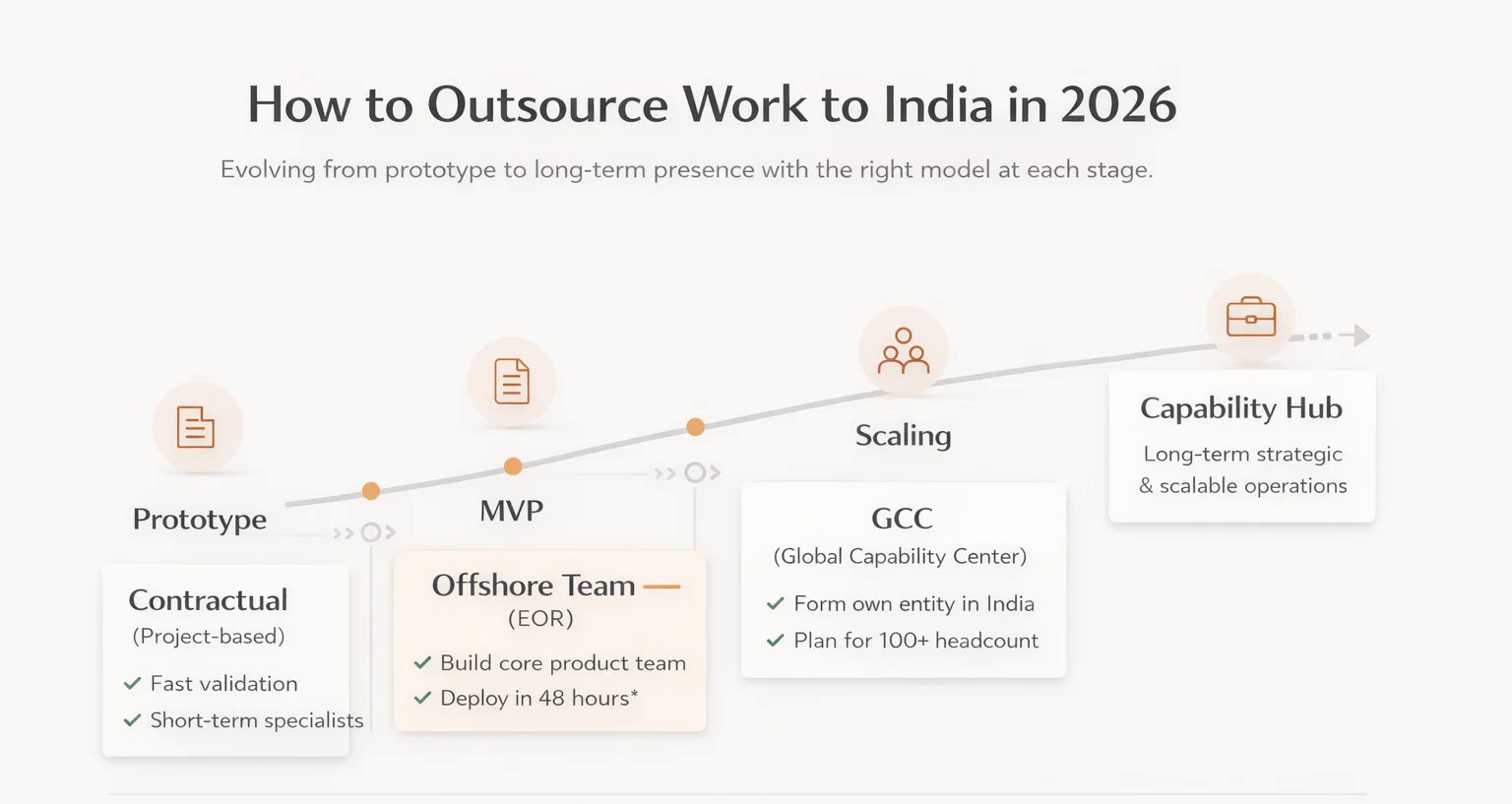
Evolution path: From prototype validation to long-term strategic operations
Option 1: Contractual / Project-Based Outsourcing
What it is
This is the most common and familiar model. You hire an Indian agency or vendor to deliver a defined scope of work, typically paid per project or via a monthly retainer.
The vendor manages hiring, execution, and delivery. You interact primarily with a project manager.
Pros
- •Fast to start
- •Low commitment
- •No hiring or compliance responsibility
- •Works well for short-term or clearly defined tasks
�-Cons
- •Limited control over team and quality
- •Knowledge often stays with the vendor
- •Harder to scale long-term
- •Priorities may shift if vendor has multiple clients
Best suited for
Option 2: Dedicated Offshore Team (Without an Indian Entity)
What it is
In this model, you build a dedicated team that works only for your company, but the team is legally employed by a local partner through an Employer of Record (EOR) or managed ODC arrangement.
You manage the team's day-to-day work. The partner handles payroll, compliance, HR, and legal obligations.
Pros
- •Much higher control than agencies
- •Faster hiring than setting up an entity
- •No need to incorporate in India
- •Team works like your internal employees
- •Easier to scale up or down
�-Cons
- •Dependence on partner for compliance and HR
- •Requires structured communication and ownership
- •Not ideal for very large teams (100+ long-term)
Best suited for
About Speed
For most in-demand roles and projects, such as web development, mobile apps, backend engineering, design, and QA, teams can often be deployed within days, sometimes even within 48 hours, due to pre-vetted talent pools and ready infrastructure.
For highly specialized or niche requirements like AI agents, blockchain development, or custom LLM training, timelines may vary, but this model is still significantly faster than traditional hiring or entity setup.
Option 3: Global Capability Center (GCC)
What it is
A GCC is your own legal entity in India, fully owned and operated by your company. You hire employees directly, control operations, and build long-term organizational capability.
Many global enterprises now use GCCs as strategic innovation and delivery hubs. Learn more about establishing your GCC.
Pros
- •Full control over hiring, culture, and IP
- •Strong employer branding in India
- •Long-term cost efficiency
- •High retention and team loyalty
- •Ideal for large-scale operations
�-Cons
- •Significant setup effort
- •Legal, tax, and compliance complexity
- •Higher upfront cost
- •Slower to start compared to other models
Best suited for
Quick Comparison: Which Model Fits You?
| Model | Speed to Start | Control Level | Setup Effort | Best For |
|---|---|---|---|---|
| Contractual | Very Fast | Low | Very Low | Short-term work, MVPs |
| Offshore Team (EOR) | Fast (48hrs*) | Medium-High | Low | Product teams, flexible scaling |
| GCC (Own Entity) | Slow (3-6 months) | Very High | High | Long-term scale (50+ team) |
* For most high-demand product and design roles. Specialized requirements may vary.
Common Mistakes Companies Make When Outsourcing to India
Choosing the cheapest option without evaluating quality
Price should never be the only factor. Poor quality work costs more in the long run.
Ignoring compliance and statutory obligations
India has strict labor laws. Non-compliance can result in penalties and legal issues.
Scaling too quickly without ownership clarity
Define roles, responsibilities, and escalation paths before rapid scaling.
Treating offshore teams as vendors, not collaborators
Integration and culture matter. Remote doesn't mean disconnected.
Underestimating communication and cultural alignment
Clear communication, documentation, and cultural understanding drive success.
These mistakes are avoidable with the right structure and partner.
How to Decide What's Right for You
Ask yourself these five critical questions:
Is this short-term or long-term work?
Short-term → Contractual. Long-term → Offshore Team or GCC.
Do I need flexibility or stability?
Flexibility → Offshore Team. Stability → GCC.
How much control do I want?
Low control → Contractual. High control → Offshore Team or GCC.
Am I ready to manage people directly?
Not ready → Contractual. Ready → Offshore Team or GCC.
Do I want to invest in India long-term?
Yes, with 50+ team → GCC. Yes, flexible → Offshore Team. Testing → Contractual.
There is no single correct answer - only what fits your current stage.
A Calm Closing Perspective
Outsourcing to India in 2026 is no longer just a cost decision. It's a strategic operating choice.
The companies that succeed are the ones that:
Choose the right model for their stage
Prioritize transparency over speed alone
Build systems that reduce chaos
Treat India as a long-term partner, not a short-term fix
With thoughtful planning, India can become one of your strongest competitive advantages.
Whether you're exploring EOR services, planning a GCC setup, or looking to build a dedicated team quickly, we help companies navigate India expansion with clarity and calm execution.
Note: All India expansion models should comply with regulations from MeitY, Ministry of Labour, EPF, ESIC, MCA, Income Tax Department, and RBI.