📌 TL;DR
- Most technology GCCs succeed when they start fast (EOR or BOT), structure correctly (WOS), and design compliance early
- Best long-term structure: Wholly Owned Subsidiary (WOS) for full operational freedom and IP control
- Fastest hiring: Employer of Record (EOR) to start hiring in weeks without entity setup
- Best speed-to-ownership bridge: BOT → WOS for rapid setup with eventual full control
- Branch/Liaison Offices are rarely optimal for tech GCCs due to RBI compliance complexity and operational restrictions
Registration Formats in India for GCCs: Complete Guide
Setting up a Global Capability Center (GCC) in India is a durable operating model choice that affects cost structure, velocity of hiring, IP control, tax exposure, governance, and exit optionality. One decision determines almost everything downstream: how your foreign company legally enters India.
This guide breaks down every viable entry format for GCCs in India in 2026-what each structure can (and cannot) do, approvals required, realistic timelines, compliance burdens, and how global companies sequence these options in real life.
Before choosing an entry format, understand that India's compliance stack involves multiple regulators: Ministry of Corporate Affairs (MCA) for companies, Reserve Bank of India (RBI) for foreign exchange, Income Tax for transfer pricing and corporate taxation, DPIIT (if you apply for government incentives or special zones), and state labor authorities (PF, ESI, Shops & Establishments).
Most technology GCCs succeed when they start fast (EOR or BOT), structure correctly (WOS eventually), and design compliance early (before hiring at scale).
Key Takeaways:
- ✓ Best long-term: WOS (Wholly Owned Subsidiary)
- ✓ Fastest start: EOR (Employer of Record)
- ✓ Best hybrid: BOT → WOS
- ✓ Avoid for tech: Branch/Liaison Offices
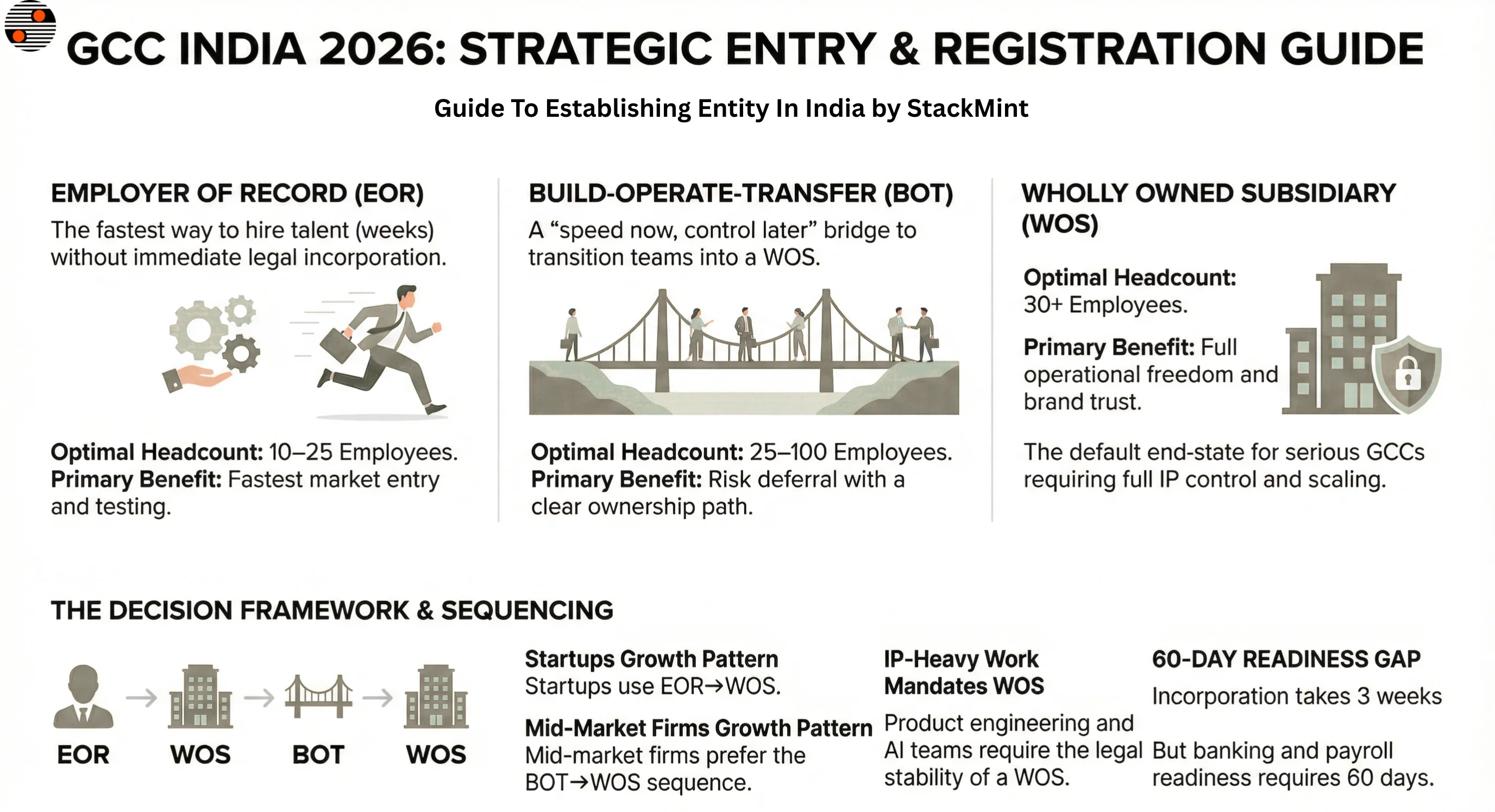
Understanding India's Regulatory Framework
India's compliance stack is multi-authority. GCCs often get delayed because teams optimize for incorporation speed but ignore downstream tax, RBI reporting, and payroll readiness.
Before diving into specific entity structures, it's critical to understand the regulatory landscape you'll be navigating. Unlike the U.S. (where most federal incorporation happens at state level) or Singapore (single-authority setup), India requires coordination across multiple regulators-each with different timelines, documentation requirements, and compliance cadences.
Ministry of Corporate Affairs (MCA)
Handles incorporation, directors, statutory filings (Companies Act / LLP Act). This is your primary regulator for entity formation and annual compliance. Learn more →
Reserve Bank of India (RBI)
Oversees foreign exchange (FEMA compliance), remittances, and approval processes for Branch/Liaison Offices. RBI approval adds 3-6 months for Branch Office. FEMA Guidelines →
Income Tax Department
Manages corporate tax (25.17% effective rate post-surcharges), transfer pricing (Form 3CEB required if cross-border transactions exceed ₹1 Cr), and PE risk assessment. Official site →
DPIIT (Department for Promotion of Industry and Internal Trade)
Optional but valuable for SEZ benefits, startup recognition, or FDI policy interpretation. Relevant if you're applying for R&D tax credits.
State Labor Authorities
EPF (Employees' Provident Fund), ESI (health insurance), Shops & Establishments Act registration, Professional Tax. Each state has slightly different rules-Karnataka and Telangana are most GCC-friendly.
Wholly Owned Subsidiary (WOS): The Default End-State
A WOS is an Indian Private Limited Company where up to 100% shareholding is held by the foreign parent. This is the most common "stable" structure for tech and product GCCs, providing full operational freedom, clean IP ownership, and a governance structure that global HQ teams already understand.
For most technology companies expanding to India, WOS becomes the long-term answer-even if they start with EOR or BOT for speed. It offers the cleanest legal structure for IP-intensive work, the most flexibility for scaling (both headcount and geographic footprint), and the simplest governance model for boards and investors who are already familiar with subsidiary structures.
India allows 100% FDI in most technology sectors under the automatic route (no government approval required), making WOS incorporation straightforward. The real complexity isn't in the incorporation itself-it's in getting operational readiness right: bank accounts, payroll systems, office leases, transfer pricing documentation, and compliance calendars.
What a WOS Can Do:
- ✓ Hire unlimited employees with full control
- ✓ Own IP and run product engineering teams (critical for captive R&D)
- ✓ Issue ESOPs for leadership hiring and retention
- ✓ Scale into multi-city operations (Bengaluru, Hyderabad, Pune, NCR)
- ✓ Run intercompany delivery models (bill parent company for services)
- ✓ Raise local debt or venture funding if needed
- ✓ Apply for SEZ status for tax benefits
Realistic Incorporation Timeline:
- • Name approval (RUN form): 1-2 days
- • SPICe+ filing with MCA: 5-7 days
- • PAN, TAN, GSTIN: 3-5 days
- • Bank account opening: 1-2 weeks (varies by bank)
- • Capital infusion + FEMA reporting: 1 week post-account
Total: 3-4 weeks to incorporation + 2-3 weeks for full operational readiness = 30-45 days end-to-end
Two Common Models: Captive vs. Product WOS
Captive Model (Cost Center)
Parent company funds the subsidiary via equity infusion or intercompany loans. India entity provides services (engineering, support, analytics) and bills at cost-plus markup (typically 5-15%) for transfer pricing compliance.
Example: A U.S. SaaS company sets up a WOS in Bengaluru to build core product features. The India team bills the U.S. parent quarterly for engineering services.
Product Model (Profit Center)
India entity operates as a revenue-generating business unit, either selling directly to Indian customers or acting as a global hub for specific product lines. More complex transfer pricing design required.
Example: A fintech company builds its India WOS as the sole developer and owner of its mobile banking app, licensing it back to global entities.
When to Choose WOS:
- ✓ Long-term commitment to India (3+ years horizon)
- ✓ Need full IP ownership and operational control
- ✓ Plan to hire 30+ employees quickly
- ✓ Want ESOP eligibility for senior hires
- ✓ Building product or R&D functions
Branch Office (BO): High Compliance, Narrow Use Cases
A Branch Office is an extension of the foreign parent company-not a separate legal entity. It requires RBI approval and operates under strict FEMA (Foreign Exchange Management Act) regulations. Once common for consultancies and law firms, it's rarely optimal for tech GCCs today.
The key distinction: a Branch Office cannot engage in "new business" in India-it can only support the parent company's existing global contracts. This makes it unsuitable for product engineering or R&D work where the India team would be creating new IP or serving Indian customers directly. Additionally, RBI scrutinizes Branch Office operations through mandatory annual filings (Audited Annual Activity Certificate), and renewal timelines can be unpredictable. For more details, see RBI's FEMA notifications.
Key Restrictions:
- ❌ Cannot do "new business" in India-only service existing global contracts
- ❌ Cannot hire freely-headcount scrutinized during RBI renewals
- ❌ Cannot own IP independently-everything flows to parent
- ❌ RBI approval required initially + periodic renewals
- ❌ Mandatory Audited Annual Activity Certificate (AAC) filed with RBI
Realistic Timeline:
RBI Approval: 3-6 months (file Form FNC-1 via AD Bank)
Post-approval setup: 2-4 weeks (PAN, TAN, bank account, GST)
Total: 4-7 months before you can hire the first employee
When Branch Office Makes Sense:
- ✓ Parent company is a consultancy, law firm, or accounting firm with multinational clients
- ✓ India operations are purely support functions (not product development)
- ✓ Headcount will stay under 20-30 for foreseeable future
- ✓ You have legal/compliance bandwidth to manage RBI reporting
Common Mistake:
Choosing Branch Office because "it sounds simpler than WOS." In reality, ongoing RBI compliance (AAC filings, FEMA reporting, activity restrictions) makes BO far more restrictive than WOS for tech GCCs.
Liaison Office (LO): Communication Only, No Commercial Activity
A Liaison Office (also called Representative Office) is even more restrictive than a Branch Office. It's designed purely for market research, communication, and coordination-no revenue-generating activity allowed. LO is essentially a "listening post"-useful for companies exploring the Indian market but not ready to set up operations. For detailed guidelines, refer to RBI's LO notification.
What LO Cannot Do:
- ❌ No hiring for product development, engineering, or service delivery
- ❌ No contracts with Indian or global clients-purely liaison role
- ❌ No revenue generation or invoicing
- ❌ Requires RBI approval (3-5 years validity, renewable)
When LO Is Used:
- ✓ Initial market research phase (6-12 months) before committing to India
- ✓ Coordinating with Indian distributors or vendors (but not selling yourself)
- ✓ Acting as communication bridge between parent company and Indian partners
Bottom Line for GCCs:
Liaison Office is almost never the right choice for technology GCCs. If you're doing real work (hiring engineers, building products, delivering services), you need WOS, EOR, or BOT-not LO.
Limited Liability Partnership (LLP): Rare for GCCs
An LLP is a hybrid structure combining partnership flexibility with limited liability. While popular for professional services firms (law, accounting, consulting), it's uncommon for technology GCCs. The main challenge: LLPs cannot issue equity shares, which makes ESOP-based hiring (critical for senior tech talent) nearly impossible. For incorporation guidelines, see MCA's LLP Act.
Why LLP Is Rarely Used for Tech GCCs:
- • FDI Restrictions: Foreign investment in LLPs is allowed only in certain sectors (automatic route for sectors where 100% FDI is permitted). Tech services generally qualify, but many GCCs prefer WOS simplicity.
- • ESOP Complexity: LLPs cannot issue equity shares, so ESOP structures require creative workarounds (profit-sharing agreements). This makes leadership hiring harder.
- • Governance Perception: Global boards and investors are more familiar with Pvt Ltd structures. LLP can create confusion during M&A or funding rounds.
When LLP Might Work:
- ✓ Small consulting or advisory GCC (under 10 people)
- ✓ Joint venture with Indian partners where profit-sharing flexibility is critical
- ✓ You want simpler annual compliance (no mandatory audit under certain thresholds)
Realistic Timeline:
Similar to WOS: 2-3 weeks for incorporation + 2-3 weeks for operational setup = ~30 days
Employer of Record (EOR): Fastest Hiring Path
An EOR is not a legal entity type-it's an operational model. The EOR provider becomes the legal employer (they hold the employment contract), while you control day-to-day work, priorities, and performance management.
Think of it as "Phase 0" before setting up your own entity. EOR lets you start hiring in India within 1-2 weeks while you figure out long-term structure (WOS or BOT). The EOR model is particularly popular with startups and mid-market companies doing their first India expansion-it offers maximum speed with minimal legal complexity. However, it's not designed for long-term scale (most companies transition out of EOR by the time they hit 25-30 employees).
What EOR Can Do:
- ✓ Hire employees in India without setting up an entity
- ✓ Handle payroll, PF/ESI compliance, TDS, labor law filings
- ✓ Let you test India talent market before committing to WOS setup
- ✓ Provide instant operational readiness (no months-long incorporation wait)
- ✓ Support multi-country hiring (useful if expanding to other APAC markets)
When EOR Breaks Down:
- ❌ Scale Constraint: Most EOR pricing becomes prohibitive beyond 20-30 employees (typical markup: 8-15% on gross payroll). At 50+ employees, you're overpaying by $200K-500K/year vs. WOS.
- ❌ IP Ownership Complexity: Work created by EOR-hired employees technically belongs to EOR entity first. You need tight IP assignment agreements.
- ❌ ESOP Ineligibility: EOR employees cannot receive parent company stock options (since they're not employees of parent/subsidiary). Limits senior hiring.
- ❌ Vendor Lock-In: Switching EOR providers mid-stream requires re-hiring everyone (termination + re-onboarding under new EOR), which disrupts operations.
Rule of Thumb:
EOR is excellent for 0-25 employees, 6-18 month timeline. Use it to:
- • Validate India as a long-term GCC location
- • Hire first engineering leaders while WOS incorporation is in progress
- • Test compensation bands and talent density in Tier 1 vs. Tier 2 cities
Beyond that scale or timeline, transition to WOS (directly) or BOT (if you want operational support during scale).
Build-Operate-Transfer (BOT): Speed + Ownership Path
BOT compresses time-to-hire while preserving a clean path to ownership. You start hiring under a partner's entity, then transfer the entire team + operations into your WOS when ready.
It's the "best of both worlds" for GCCs that need speed (like EOR) but want long-term control (like WOS). BOT is particularly popular with Series B-D companies that need to scale quickly (50-100 people in 12-18 months) but don't have in-house India operations expertise. The BOT partner handles all the "operational plumbing"-payroll, compliance, office setup, IT infrastructure-while you focus on hiring and product delivery. Then, once you're ready (typically 18-24 months in), the team transfers to your WOS with full continuity.
⚡ Speed
Hiring starts in 2-4 weeks (partner's entity is already set up). No waiting for your own incorporation.
🎯 Risk Deferral
Validate your India strategy (talent, cost, productivity) before committing to long-term entity ownership.
📋 Governance
Clear SLAs, milestone-based pricing, and structured reporting. Partner handles compliance while you focus on hiring + delivery.
🔄 Clean Transfer
Team moves to your WOS with full continuity-no re-hiring, minimal disruption. IP and contracts transfer seamlessly.
Typical BOT Phasing:
- Phase 0 (Months 0-3): Build - Partner handles recruiting, onboarding, payroll, compliance setup. You interview, approve hires, define OKRs. Your WOS incorporation happens in parallel.
- Phase 1 (Months 6-24): Operate - Team scales under partner's entity. Partner provides office space, IT infra, HR, finance, legal support. You control roadmap and performance management.
- Phase 2 (Months 18-36): Transfer - Team and operations move to your WOS. Partner assists with labor law compliance (consent letters, continuity of service), lease handover, vendor re-contracting.
BOT Transfer Design: What to Plan Early
- ✓ IP Assignment: Ensure all work product is assigned to you (not BOT partner) from day one. Use "work for hire" agreements.
- ✓ Employee Continuity: Draft consent letters and service continuity agreements (critical for gratuity, PF, leave balances).
- ✓ Transfer Pricing: If BOT partner is billing parent company, structure it as a "management fee" or "recruitment + admin service" to avoid PE risk.
- ✓ Exit Costs: Negotiate fixed transfer fees upfront (typical: 1-3 months of salary per employee, or flat milestone fee).
When BOT Makes Sense:
- ✓ You want to hire 10-50 people in first 6-12 months
- ✓ Your board/CFO needs "proof of concept" before approving WOS
- ✓ You lack in-house India expertise (real estate, payroll, compliance)
- ✓ You want full ownership eventually (not perpetual EOR dependence)
How to Choose: Decision Framework
Most companies agonize over entity structure for months. Here's a faster decision framework based on 5 variables:
1. Is India doing IP-heavy work (product engineering, R&D, core algorithms)?
If YES: Prioritize WOS (direct) or BOT → WOS. You need clean IP ownership from day one. EOR works only if you have airtight IP assignment agreements.
If NO (support, ops, back-office): EOR or BOT both work fine. WOS is still cleaner long-term if scaling past 30 people.
2. Is speed the #1 constraint (need to hire in next 4-6 weeks)?
If YES: EOR is fastest (2 weeks to first hire). BOT is second-fastest (3-4 weeks). WOS will take 30-45 days minimum.
If NO (you have 2-3 months runway): Start WOS incorporation immediately. You'll be operational by the time hiring pipeline fills.
3. How fast will you scale (headcount trajectory)?
0-25 people, slow growth: EOR is fine for 12-18 months.
25-100 people in 12 months: Go straight to WOS or start with BOT.
100+ people in 18 months: You need WOS from day one. EOR economics break down, and BOT transfer becomes operationally complex at that scale.
4. Do you have in-house India compliance expertise?
If NO: BOT is best-partner handles payroll, tax, labor law, real estate while you learn. Alternatively, use EOR + hire a fractional CFO/legal advisor.
If YES: WOS gives you full control without dependency on external partners.
5. Is your sector highly regulated (fintech, healthcare, defense)?
If YES: WOS is often mandatory for regulatory approvals (RBI licenses, data localization compliance). EOR/BOT may not satisfy regulator requirements.
If NO: All options are viable. Choose based on speed + scale needs.
Common Sequencing Patterns: What Real GCCs Do
Most successful GCCs don't pick one structure forever-they sequence through phases as they scale and mature.
Pattern 1: Startup → EOR → WOS (Fast Validation, Then Commit)
Profile: Early-stage tech company (Series A/B), first time hiring in India, 1-2 year horizon to validate GCC model.
Sequence:
- • Months 0-3: Hire first 5-10 engineers via EOR
- • Months 3-12: Validate productivity, cost, cultural fit. Start WOS incorporation in parallel (Month 6)
- • Months 12-18: Transition team from EOR to WOS. Scale to 30-50 employees.
Why it works: Minimal upfront commitment, fast iteration, clean exit if India doesn't work out.
Pattern 2: Mid-Market → BOT → WOS (Speed + Support, Then Own)
Profile: Series C-D company or growth-stage PE-backed firm, need to scale quickly (50-150 people in 18 months) but lack India ops experience.
Sequence:
- • Months 0-6: Partner builds team to 20-30 under BOT. Partner provides office, HR, payroll, compliance.
- • Months 6-18: Scale to 80-100 people. WOS incorporation happens in parallel (Month 9).
- • Months 18-24: Transfer team to WOS. Partner assists with transition, then exits.
Why it works: You get both speed AND operational support during critical scaling phase. Clean path to ownership.
Pattern 3: Enterprise → Direct WOS (Long-Term, Full Control)
Profile: Public company or F500 enterprise, committed to India for 5+ years, need full governance/compliance control from day one.
Sequence:
- • Month 0: Start WOS incorporation immediately. Hire fractional CFO/legal advisor for India compliance.
- • Months 0-2: Incorporate WOS, open bank account, hire first operations manager (who can be hired via EOR temporarily if needed).
- • Months 2-6: Hire first 20-30 employees directly into WOS. Set up office, payroll systems, IT infra.
- • Months 6-24: Scale to 100-500+ employees. No dependency on external partners.
Why it works: Maximum control, no transfer friction, cleaner audits/governance for public companies. Worth the 2-3 month setup delay if you have strong internal ops.
Common Mistakes to Avoid
After working with 100+ GCCs, here are the mistakes we see most often-and how to avoid them:
1. Choosing Branch Office Because "It Sounds Simpler"
The Mistake: Founders assume BO = less paperwork than WOS. In reality, RBI compliance (AAC filings, FEMA reporting, activity restrictions) makes BO far more restrictive.
Fix: Unless you're a consultancy with multinational clients, default to WOS (or EOR/BOT if you need speed).
2. Starting Hiring Before Entity Structure is Decided
The Mistake: Making verbal offers to candidates without knowing if you'll use EOR, BOT, or WOS. Then scrambling when candidates ask for offer letters.
Fix: Decide entity structure BEFORE opening JDs. If you're unsure, start with EOR (2 weeks to operational) while you finalize long-term plan.
3. Ignoring Annual Activity Certificate (AAC) for Branch Offices
The Mistake: Setting up Branch Office, then forgetting about mandatory RBI reporting (audited AAC due within 6 months of fiscal year-end). Missing this can trigger penalties or RBI scrutiny.
Fix: If you must use BO, set calendar reminders for AAC filing + engage a CA firm with FEMA expertise from day one.
4. No Transfer Pricing Planning for WOS
The Mistake: Setting up WOS, hiring 50 engineers, then realizing you have no intercompany agreement in place. When tax authorities ask how you priced services to parent company, you have no documentation.
Fix: Draft a Master Services Agreement (MSA) + Transfer Pricing Policy BEFORE your first cross-border invoice. Use cost-plus method (5-15% markup on costs) for captive GCCs. File Form 3CEB (TP Report) annually if intercompany transactions exceed ₹1 Cr.
5. Delaying ESOP Design Until "Later"
The Mistake: Hiring senior leaders (VP Eng, Head of Product) with promise of equity "once we figure out ESOPs." Then realizing your EOR or LLP structure doesn't support stock options, and you can't retroactively grant them.
Fix: If equity is critical for hiring, prioritize WOS from day one (or plan BOT → WOS transition within 12 months). Draft ESOP scheme during incorporation-it's easier to set up early than retrofit later.
Conclusion: Choosing the Right Path for Your GCC
Setting up a GCC in India isn't a one-size-fits-all decision. The right entity structure depends on your timeline, headcount trajectory, IP sensitivity, compliance maturity, and long-term commitment to India.
For most technology companies, the optimal path is one of three patterns: Startup → EOR → WOS (fast validation), Mid-Market → BOT → WOS (speed + support), or Enterprise → Direct WOS (full control from day one). Branch Office and Liaison Office are rarely optimal for tech GCCs-they're designed for specific use cases (consultancies, market research) that don't align with product development or engineering work.
The key is to start fast, structure correctly, and design compliance early. Don't wait months to make a perfect decision-start with EOR or BOT if you need speed, then transition to WOS once you've validated the model. The companies that succeed in India are those that prioritize hiring velocity while keeping long-term ownership in sight.
Next Steps:
- → Read our guide on building your team in 48 hours using EOR models
- → Explore how BOT works in practice with real-world timelines
- → Learn about EOR vs. WOS trade-offs for different company stages
- → Discover our GCC Setup Services for end-to-end incorporation support
- → Check out Employer of Record services to start hiring immediately
Need help deciding which structure is right for your company? StackMint has helped 100+ companies set up GCCs in India-from entity selection to operational readiness. We handle incorporation, compliance, payroll, and transfer design so you can focus on hiring and scaling.