📌 TL;DR
- ODC demands 12-18 months of operational investment before ROI starts appearing
- GCC requires $500K+ in fixed infrastructure costs before hiring your first engineer
- VCT delivers operational teams in 48 hours but caps team size at 50 engineers
- Your choice depends on timeline tolerance, capital availability, and control requirements
Every founder, CTO, and operations leader I talk to wants the same thing: a high-performing engineering team in India without the operational nightmare. They've read the case studies, seen the cost savings, and heard the success stories. But nobody talks about what happens after the setup.
Here's what they don't tell you: The setup is 20% of the work. The operations are the other 80%.
Whether you choose an Offshore Development Center (ODC), a Global Capability Center (GCC), or a Virtual Captive Team (VCT), you're not just picking a label. You're picking an operational model that will define your team's trajectory for years.
This isn't a "which one is best?" article. It's a "here's what actually happens after month one" article. Let's break down the operational reality of each model.
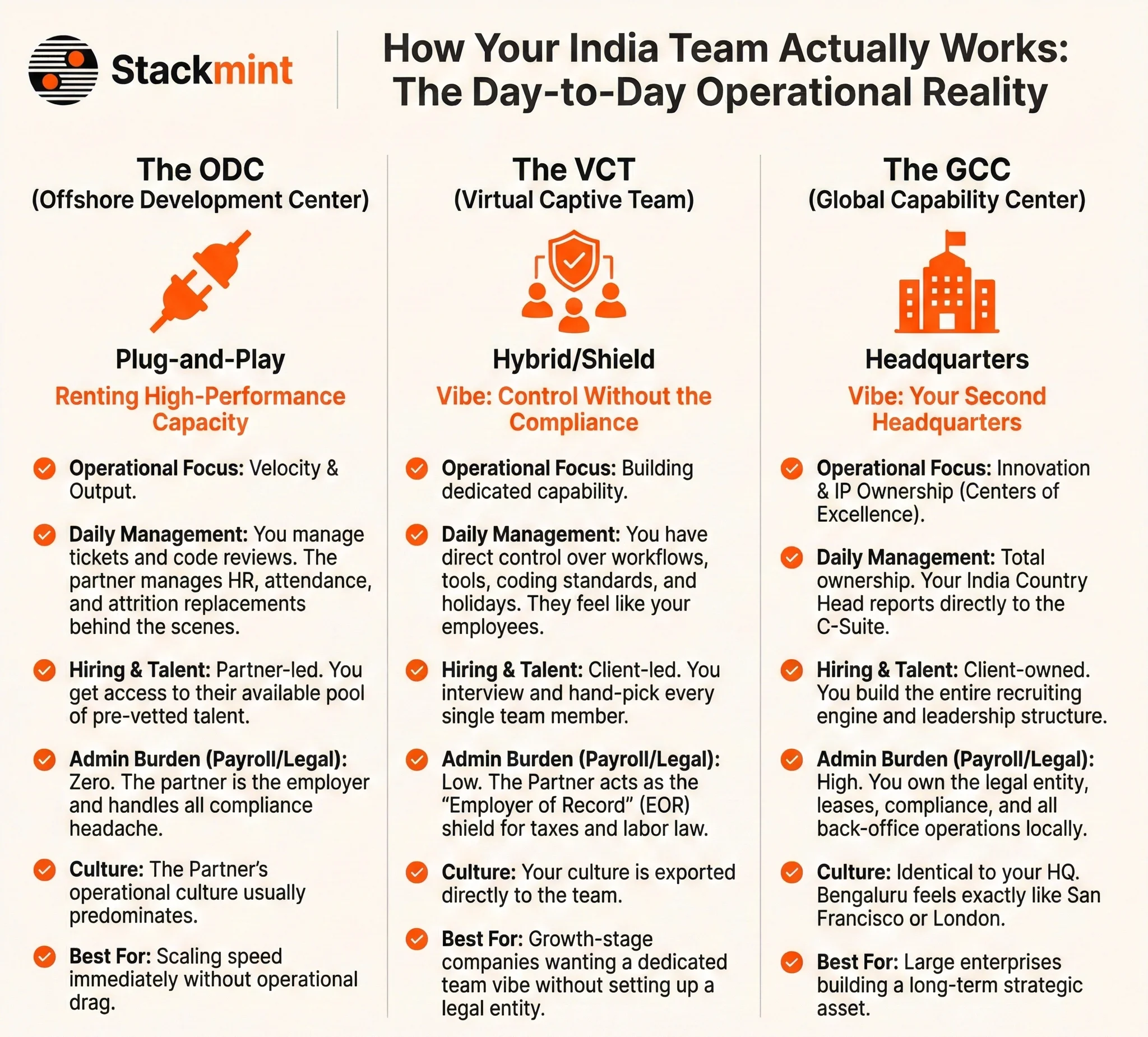
The ODC Reality: When Control Comes at a Cost
What it looks like on paper: Full control, dedicated team, your brand, your processes.
What it looks like in practice: You own everything, which means you manage everything.
The First 6 Months: The Infrastructure Sprint
Before you hire your first engineer, you're building the entire operational backbone:
- Legal Entity Registration: 8-12 weeks to set up your Indian entity (private limited company registration with MCA)
- Office Space: Commercial lease, furniture, IT setup, security systems
- Compliance Infrastructure: PF/ESI registration, GST, professional tax, labor law compliance
- HR Systems: Payroll software, benefits administration, attendance tracking
- IT Infrastructure: Laptops, servers, software licenses, network security
Real cost: $50K-$150K before your first engineer writes a line of code.
Months 6-18: The Operational Grind
Now you're running a full-fledged Indian office. This means:
- Monthly Compliance: PF filings, ESI returns, GST submissions, TDS deposits
- Quarterly Audits: Statutory audits, tax audits, transfer pricing documentation
- Annual Obligations: Income tax returns, annual reports, board meetings
- Employee Management: Notice periods (typically 60-90 days in India), exit formalities, full-and-final settlements
- Vendor Management: Office maintenance, IT support, security services, cafeteria
Operational overhead: 15-20% of total payroll costs, plus 2-3 full-time operations roles.
Who ODC Works For:
- You're planning to scale to 100+ engineers in India
- You have 12-18 months before you need ROI
- You're willing to invest $200K+ upfront in infrastructure
- You have operations bandwidth to manage ongoing compliance
- Brand presence in India matters to your business strategy
Who ODC Doesn't Work For:
- You need a team operational in under 6 months
- You're testing India as a hiring market (not committing long-term)
- You don't have operations expertise to handle Indian compliance
- Your team size will stay under 50 engineers
Bottom line: An ODC gives you maximum control, but that control requires ongoing operational investment. If you're not ready to manage a full Indian entity, the savings get eaten by compliance costs and operational overhead.
The GCC Reality: When Scale Demands Structure
What it looks like on paper: Enterprise-grade setup, multi-function teams, strategic India presence.
What it looks like in practice: You're building an entire business unit in India, not just a dev team.
The First 12 Months: The Foundation Build
A GCC isn't just about engineering. You're setting up a strategic capability center with multiple functions (as detailed in NASSCOM's GCC report):
- Leadership Team: GCC Head, HR Head, Finance Head (hired months before the first engineer)
- Office Infrastructure: Grade-A office space (20,000+ sq ft), conference rooms, collaboration zones
- Multi-Function Teams: Engineering, product, design, data, potentially R&D
- Enterprise Systems: ERP, HRIS, compliance platforms, security infrastructure
- Legal/Tax Structure: Tax residency certificates, RBI-compliant transfer pricing policies, international agreements
Real cost: $500K-$1M in year one, before scaling the team.
Year 2+: The Scale Phase
Once the foundation is set, you're operating at a different scale:
- Hiring Velocity: 50-100 hires per year, requiring dedicated recruitment team (learn about incentives)
- Compliance Complexity: International tax planning, transfer pricing audits, regulatory inspections
- Employee Benefits: Health insurance for families, retirement benefits, learning budgets, employee stock options
- Retention Programs: Career development, internal mobility, training academies
- Vendor Ecosystem: Managed IT, facility management, background verification, legal counsel
Operational overhead: 10-12% of payroll (lower than ODC due to economies of scale), but fixed costs remain high.
Who GCC Works For:
- You're planning to hire 200+ people across multiple functions
- You have a 3-5 year strategic roadmap for India expansion
- You're willing to invest $1M+ in the first 18 months
- You want to build a self-sustaining India leadership team
- Your competitors are establishing GCCs (industry norm)
Who GCC Doesn't Work For:
- You're building a team of under 100 people
- You need immediate ROI (GCCs typically take 24+ months to break even)
- You don't have executive bandwidth to oversee India operations
- Your business model might pivot in the next 2 years
Bottom line: A GCC is the right choice when India is a strategic market, not just a cost-saving exercise. If you're not planning multi-year investment and multi-function expansion, you're over-engineering your India presence.
The VCT Reality: When Speed Beats Everything
What it looks like on paper: Instant team, zero setup, operational support included.
What it looks like in practice: You're renting infrastructure instead of building it, which works until it doesn't.
Week 1-2: The Fast Start
This is where VCT shines. While ODC and GCC teams are still in legal paperwork, your VCT is operational:
- Day 1: Kick-off call, role specifications finalized
- Day 3-5: Candidate profiles shared, interviews scheduled
- Day 10-14: Offers accepted, laptops shipped, onboarding begins
- Day 15: First engineer writes code
Setup cost: $0. You pay salaries plus a management fee (typically 15-25% of payroll).
Month 3-12: The Operational Advantage
This is where the VCT model proves its value:
- HR/Payroll: Managed by the VCT provider (PF, ESI, tax deductions, salary processing)
- Compliance: Entity-level compliance handled by provider (you're not liable)
- Benefits: Health insurance, leave management, notice period buyouts managed by provider
- IT Support: Laptop procurement, software licenses, remote work infrastructure
- Exit Management: Notice periods, severance, legal formalities handled by provider
Operational overhead: Zero for you. The management fee covers all of this.
Month 12+: The Scale Constraint
Here's where VCT limitations appear:
- Team Size Cap: Most VCT providers struggle to manage teams over 50 engineers effectively
- Control Limitations: You can't set custom benefits, implement your HR policies, or adjust compensation structures freely
- Cost Arbitrage: As you cross 30-40 engineers, the management fee starts eating into the cost savings
- Brand Disconnect: Engineers are employed by the VCT provider, not your company (impacts retention)
Break-even point: Around 40-50 engineers, depending on management fee structure. Beyond this, ODC becomes cost-effective.
Who VCT Works For:
- You need a team operational within 30 days
- You're testing India as a hiring market before committing to a full entity
- Your team size will stay under 50 engineers for the next 2+ years
- You don't have operations bandwidth to manage compliance
- You want flexibility to scale up/down without entity-level liability
Who VCT Doesn't Work For:
- You're planning to scale to 100+ engineers
- You need full control over HR policies and employee benefits
- Brand equity in India is critical to your hiring strategy
- You want to eventually convert the team to a full ODC/GCC
Bottom line: A VCT is the fastest, lowest-risk way to build in India. But it's a stepping stone, not a destination. If you know you'll scale beyond 50 engineers, plan your exit strategy early.
The Real Comparison: What Actually Matters
Let's cut through the marketing language and look at what actually determines success:
| Factor | ODC | GCC | VCT |
|---|---|---|---|
| Time to First Hire | 4-6 months | 6-12 months | 2-4 weeks |
| Setup Cost | $50K-$150K | $500K-$1M | $0 |
| Operational Overhead | 15-20% of payroll | 10-12% of payroll | 15-25% management fee |
| Break-Even Timeline | 12-18 months | 24-36 months | Immediate |
| Optimal Team Size | 50-150 engineers | 200+ across functions | 10-50 engineers |
| Control Level | Full control | Full control + autonomy | Limited control |
| Compliance Risk | High (you own it) | High (you own it) | Low (provider owns it) |
| Exit Complexity | High (entity closure) | Very high (multi-year wind-down) | Low (contract termination) |
The pattern is clear: ODC and GCC give you control at the cost of complexity and capital. VCT gives you speed at the cost of scale and control.
The Verdict: What Works for Whom
After working with 50+ companies building teams in India, here's the decision framework that actually works:
Choose VCT if:
- You need a team operational within 30-60 days
- You're not sure India is a long-term play yet
- Your target team size is under 50 engineers
- You don't want to deal with compliance and HR operations
Reality check: VCT is perfect for getting started fast, but plan your transition to ODC if you know you'll scale beyond 50 engineers. The management fee will eat into savings as you grow.
Choose ODC if:
- You're planning to scale to 50-150 engineers in India
- You have 12+ months before you need ROI
- You want full control over HR policies, benefits, and branding
- You have operations bandwidth to manage ongoing compliance
Reality check: ODC is the sweet spot for most mid-stage companies. You get control without the massive upfront investment of a GCC. But don't underestimate the operational complexity-budget for 2-3 full-time ops roles.
Choose GCC if:
- You're planning to hire 200+ people across multiple functions (engineering, product, data, ops)
- India is a strategic market for your business, not just a cost play
- You have $1M+ to invest in year one and patience for 24+ month ROI
- Your competitors are establishing GCCs (industry expectation)
Reality check: GCC is an enterprise play. If you're a startup or mid-stage company, you're probably over-engineering your India presence. Start with VCT or ODC and graduate to GCC when the business case is proven.
The Hybrid Approach (What Actually Works):
Most successful companies don't pick one model forever. They evolve:
- Phase 1 (0-12 months): Start with VCT to test product-market fit and validate India as a hiring market
- Phase 2 (12-24 months): Transition to ODC once team size crosses 30-40 engineers and you're confident in long-term India presence
- Phase 3 (24+ months): Upgrade to GCC when you're scaling beyond 150 engineers and adding non-engineering functions
Conclusion
The bottom line: Don't pick the model based on what sounds impressive. Pick it based on timeline, team size, and operational bandwidth. The best model is the one that matches your execution capacity, not your aspirations.
If you're trying to figure out which model fits your business, we've helped 50+ companies make this exact decision. Let's talk through your specific situation and build the right India strategy for your timeline and goals.