
📌 TL;DR
- Establishing a traditional India GCC demands 4-6 months of legal incorporation, heavy CapEx, and complex FDI compliance.
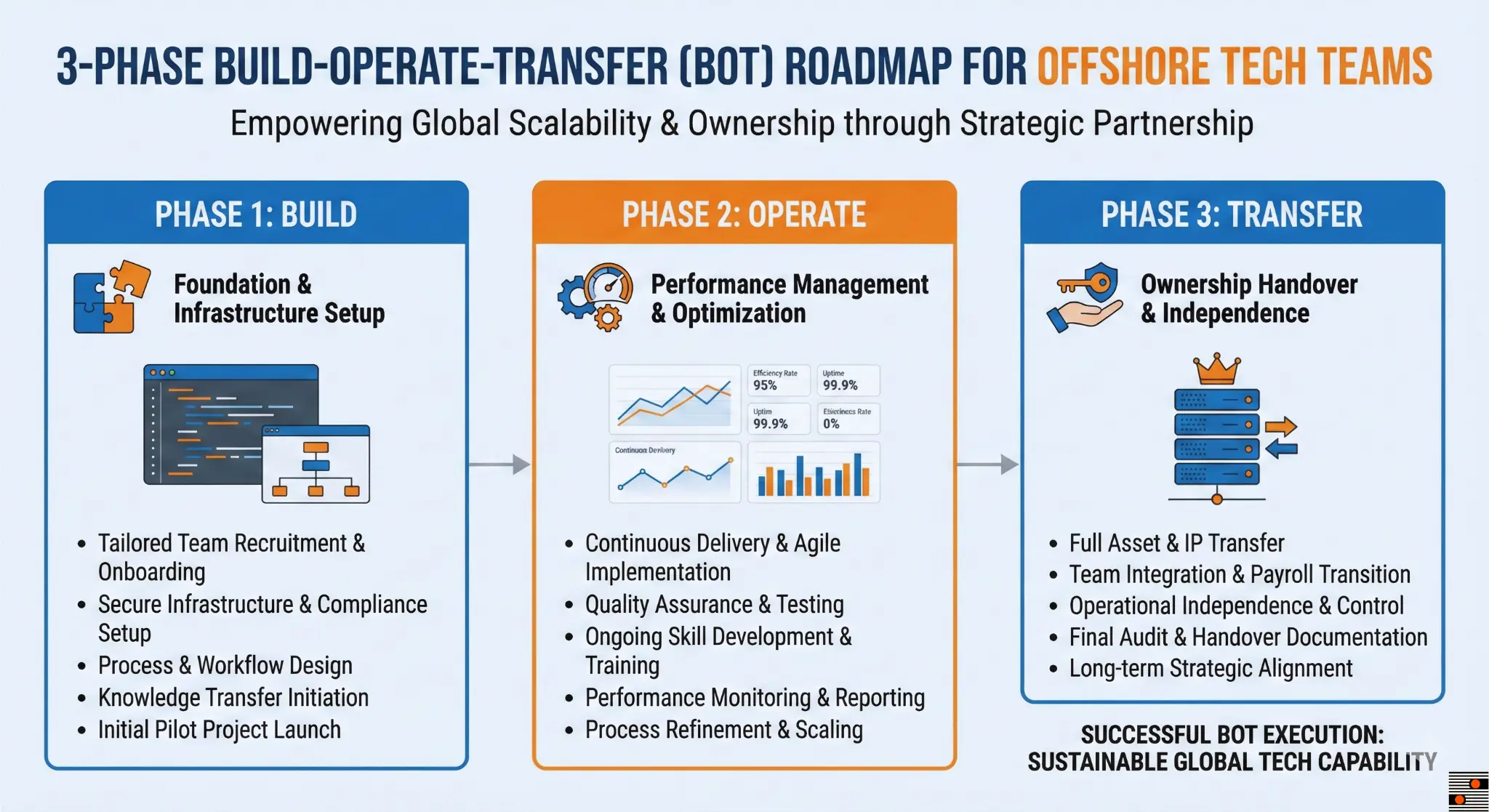
- The Build-Operate-Transfer (BOT) model structures expansion in progressive stages, starting with an Employer of Record (EOR) 'legal firewall'.
- Phase 1 (Build): Deploy a Virtual Captive Team within 48 hours using a warm bench, bypassing massive upfront friction.
- Phase 2 (Operate): Embed a 'Shadow Operations' layer to enforce rigorous engineering excellence and standardize CI/CD as the team scales.
- Phase 3 (Transfer): Seamlessly transfer all proprietary IP, employment contracts, and hardware into your own independent, Wholly Owned Subsidiary.
The Hook: Escaping the "All-or-Nothing" Trap
Setting up a Global Capability Center (GCC) in India is universally recognized as the holy grail for ambitious United States and United Kingdom scale-ups aiming to dominate their respective markets. By 2026, the Indian GCC ecosystem has matured into a formidable $64.6 billion economic engine, hosting over 1,900 capability centers that employ more than 1.9 million professionals.
These centers are no longer relegated to back-office operational assistance; they have transitioned into strategic capability hubs driving core product engineering, advanced artificial intelligence integrations, and end-to-end enterprise digital transformation. For technology founders and Chief Technology Officers, establishing an India footprint is no longer merely a labor arbitrage play designed to cut costs; it is an existential requirement for maintaining operational velocity, securing highly specialized technical talent, and extending capital runway in an increasingly constrained macroeconomic funding environment. Leveraging offshore senior engineering talent allows startups to reduce fully loaded labor costs by 39% to 60%, effectively doubling or tripling their operational runway without sacrificing technical output.
The Structural Flaw: However, despite the undeniable strategic advantages, founders routinely fall victim to the "all-or-nothing" trap. The prevailing assumption within the venture capital ecosystem is that establishing a proprietary India presence requires an immediate, massive capital expenditure project on day one.
Traditional GCC setups demand the immediate incorporation of a Wholly Owned Subsidiary (WOS) or Joint Venture. This requires navigating convoluted foreign direct investment regulations, executing multi-year commercial real estate leases in premium IT corridors, and retaining expensive corporate law firms simply to gain the legal right to hire the first local engineer. This front-loaded friction exposes scale-ups to extreme operational, regulatory, and financial risk before product-market fit or offshore team viability is even definitively proven.
Faced with this legal and logistical nightmare, founders frequently compromise. Rather than pursuing the GCC vision, they settle for hiring fragmented networks of messy freelancers or engaging transactional outsourcing agencies. While this approach bypasses the immediate legal hurdles of entity formation, it severely dilutes intellectual property protection, fractures company culture, and virtually eliminates the parent company's direct control over long-term architectural decisions and code quality.
The smartest, most capital-efficient technology companies recognize a fundamental truth: an India expansion must be treated as a phased transition, not an overnight switch. The recent emergence of the "Nano GCC"—highly specialized hubs of 5 to 100 domain experts focused on strategic capability rather than massive scale—proves that massive organizational muscle is no longer a prerequisite for offshore excellence.
| Strategic Approach | Initial Capital Outlay | Legal/Compliance Burden | Time-to-Market | Long-Term Strategic Value |
|---|---|---|---|---|
| Traditional WOS (Day 1) | Extremely High (Leases, Setup) | Borne entirely by Startup | 4 to 6 Months | High |
| Transactional Outsourcing | Low | Minimal | 4 to 8 Weeks | Low (IP Risk, High Attrition) |
| StackMint 3-Phase BOT | Zero CapEx | Borne entirely by StackMint | 48 Hours | High (Seamless Transfer) |
The BOT roadmap transforms a high-risk corporate undertaking into a measurable, iterative process, providing scale-ups with the structural agility required to navigate the 2026 talent landscape.
Phase 1: BUILD (The Virtual Captive Team - Months 1 to 12)
In the hyper-competitive startup ecosystem, speed is a critical survival metric. The most vital key performance indicator for any organization expanding globally is "time-to-keyboard"—the duration between identifying a specialized talent gap and deploying a productive engineer actively committing code. Traditional hiring cycles in the US and UK currently average 95 days, draining management bandwidth, stalling critical product releases, and allowing faster-moving competitors to capture market share. Attempting to build a fully-owned captive center from scratch compounds this delay exponentially, adding three to six months of legal, infrastructural, and administrative setup before recruitment can even theoretically begin.
Phase 1 of the StackMint BOT roadmap eliminates this structural friction entirely by immediately deploying a Virtual Captive Team (VCT). This is where StackMint delivers its most immediate, quantifiable value. The VCT model acts as a highly controlled bridge period during which a dedicated "virtual" capability center is set up, owned, and operated on behalf of the client.
The 48-Hour Operational Reality
Through the VCT framework, StackMint engineers a "Talent Velocity" paradigm that fundamentally disrupts traditional timelines. Rather than embarking on a protracted, multi-month search from scratch, StackMint operates a sophisticated "Warm Bench" model. By continuously maintaining an active pipeline of pre-vetted, high-caliber engineering talent across highly sought-after domains—such as Artificial Intelligence integration, React.js, Node.js, Python, and PostgreSQL—elite developers can be deployed and fully operational in as little as 48 hours. Even when a startup requires highly niche, custom-sourced roles, the process typically takes only two to three weeks, compared to the standard three to four months required in Western markets.
The Virtual Captive Team operates fundamentally differently from traditional IT staff augmentation or managed services. Under the VCT model, the deployed engineers are not shared resources juggling multiple accounts for different vendors; they are 100% dedicated to the parent scale-up. They integrate directly into the parent company's Slack channels, push code exclusively to the parent's GitHub repositories, and participate in daily Jira stand-ups and sprint planning sessions as fully integrated, native team members. To the parent company's Chief Technology Officer and engineering leadership, the VCT functions exactly like an internal team, ensuring absolute alignment with the core product vision and architectural standards.
The EOR Legal Firewall and Capital Efficiency
The true strategic advantage of Phase 1 lies beneath the surface, embedded in the underlying legal and compliance architecture. During the first 12 months, StackMint acts as the Employer of Record (EOR). In the highly complex, shifting landscape of Indian labor law, the EOR model serves as an impermeable "legal firewall" between the foreign startup and domestic regulatory agencies.
India's compliance environment involves a labyrinth of overlapping state and federal regulations, complex tax withholding mandates, and the impending consolidation of 29 disparate labor laws into the 4 New Labor Codes slated for implementation. Navigating this regulatory shift without a dedicated local legal team is virtually impossible for a foreign startup. By operating as the local legal entity, StackMint absorbs 100% of the compliance liability.
The StackMint EOR architecture assumes complete responsibility for:
- Contractual Execution: Drafting and executing locally compliant employment contracts that protect the parent company's interests.
- Financial Operations: Running localized payroll, calculating tax withholdings, and ensuring mandatory provident fund contributions.
- Infrastructure Provisioning: Procuring, provisioning, and securing enterprise-grade hardware and managing local IT support.
- Human Resources: Administering localized health benefits, managing leaves, and handling day-to-day HR dispute resolution.
This comprehensive insulation allows the US or UK company's leadership to focus exclusively on shipping code, refining product architecture, and accelerating the roadmap. The financial efficiency of this phase is highly compelling. The cost multiplier during the VCT phase typically rests between 1.7x and 1.8x of the employee's Cost to Company (CTC). When factoring in the absolute elimination of legal overhead, capital expenditure, and administrative bloat associated with a traditional captive setup, this represents a massive optimization of financial resources.
| Phase 1 Operational Focus | Handled by StackMint (EOR) | Handled by Client (Scale-up) |
|---|---|---|
| Talent Sourcing & Vetting | Primary Responsibility (Warm Bench) | Final Technical Interview/Approval |
| Payroll & Tax Compliance | 100% Liability and Execution | Zero Involvement |
| Hardware & IT Provisioning | Procurement and Security Setup | Access Management (SSO, GitHub) |
| Task Management & Sprint Planning | Zero Involvement | 100% Direct Control (Jira, Slack) |
Phase 1 provides the ultimate, de-risked environment for validating the offshore strategy. Startups can test cultural fit, establish robust asynchronous workflows, and definitively measure the Return on Investment (ROI) of the India team without triggering Permanent Establishment (PE) tax risks. A PE designation—which occurs when foreign entities conduct sustained, high-value economic activities without proper local incorporation—can lead to severe double taxation penalties. The EOR model mitigates this risk during the critical validation phase, providing the startup with maximum operational flexibility and zero initial capital risk.
Phase 2: OPERATE & SCALE (Months 12 to 24)
Once the offshore engineering nucleus proves its value—consistently delivering high-quality code and integrating seamlessly with onshore counterparts—organizations inevitably push for rapid scaling. Scaling a team from an initial pod of 3 engineers to a robust, multi-disciplinary unit of 15 to 50+ practitioners introduces profound structural and cultural challenges.
Growth without intentional design and operational maturity invariably leads to a degradation of performance. If unmanaged, the offshore team devolves into a low-value task-execution hub plagued by high attrition, architectural fragmentation, and the "support unit" stigma, requiring constant micromanagement from the home office. Phase 2 of the BOT roadmap transitions the primary focus from raw recruitment velocity to operational maturity and delivery excellence. During this critical window (Months 12 to 24), StackMint embeds a sophisticated operational layer—a localized "Shadow Operations" team—that acts as the nervous system for the expanding tech hub.
Implementing Shadow Operations and Tech Delivery Optimization
High-performance GCC tech teams must transcend basic execution and assume end-to-end ownership of complex product lifecycles. Achieving this requires structured Shadow Operations. Unlike isolated offshore teams that operate at a vast distance from global decision-making—suffering from fragmented context, late prioritization signals, and misaligned strategic roadmaps—the Shadow Operations layer proactively builds scalable "paved roads" for the engineering teams.
Architectural Governance
Moving beyond ad-hoc coding to enforce rigorous engineering excellence. The Shadow Operations team ensures that code reviews, pair programming sessions, and architectural design discussions become protected, non-negotiable spaces within the sprint cycle.
Standardized CI/CD and Performance Metrics
Optimizing the specific tech delivery pipeline is paramount. As teams scale, StackMint implements outcome-based Objectives and Key Results (OKRs). For example, scaling operations might mandate Key Results such as increasing deployment frequency from two to five times a week, reducing the change failure rate to sub-5%, and shrinking Mean Time To Restore (MTTR) from 60 minutes to under 15 minutes.
Documentation Culture
Scaling teams fail when institutional knowledge is siloed within individual developers. The operational layer mandates a shift to asynchronous communication, requiring comprehensive runbooks, decision logs, and detailed "why we built it this way" documentation. This neutralizes cross-team communication bottlenecks and drastically reduces onboarding time for new engineers.
Structuring Leadership Density and Custom HR Policies
A critical, recurring error that scale-ups make is scaling the engineering base faster than the leadership layer. Adding dozens of junior and mid-level developers without adequate engineering managers results in severe delivery bottlenecks, technical debt, and ultimately, burnout. StackMint actively manages the "team architecture" by introducing product squads, dedicated platform teams, and clear ownership boundaries early in the scaling process.
StackMint prioritizes "Leadership Density"—hiring engineering managers and tech leads before volume hiring begins. This prevents the dangerous phenomenon of "org mirroring," where startups blindly replicate their onshore hierarchical structures without adapting to local Indian market dynamics or the specific needs of a remote capability center. Furthermore, hiring strategies pivot to focus on "contextual experience," seeking engineers who have previously navigated complex modernization efforts or product ownership challenges, thereby shortening the time-to-impact.
Simultaneously, India's tech ecosystem is defined by a fierce, ongoing war for top-tier talent. Employment churn is highly disruptive. StackMint deploys localized, custom HR policies designed to maximize retention in the Indian context:
- Continuous Learning Organizations: Launching structured leadership development programs, providing AI integration training, rotating incident commanders, and hosting internal tech talks.
- Progressive Governance: Governance shifts toward performance optimization, granting high-performing teams local autonomy within defined global alignment boundaries.
- Engagement Intelligence: Fostering a culture where engineers feel a direct connection to the product's success through targeted feedback loops and clear growth opportunities.
By the culmination of Phase 2 (Month 24), the Virtual Captive is no longer a peripheral experiment; it is a mature, high-functioning, and deeply integrated extension of the parent company's engineering apparatus. The asset is now primed, structurally and culturally, for the final transfer.
Phase 3: TRANSFER (The Handover - Month 24+)
The ultimate, compounding payoff of the BOT model is the seamless acquisition of a fully stabilized, culturally integrated, and high-performing offshore asset. By the end of Phase 2, the scale-up's macroeconomic position has typically shifted: Annual Recurring Revenue (ARR) has grown significantly, product-market fit is indisputable, and the executive board or investors demand full strategic control, data sovereignty, and direct IP ownership.
Furthermore, maintaining a team that has scaled beyond 15–20 personnel engaging in core, revenue-generating R&D activities under an EOR structure significantly escalates the risk of triggering Permanent Establishment (PE) status under the US-India Double Taxation Avoidance Agreement (DTAA). High-value operations limit the ability to argue against PE status, necessitating a transition to a dedicated legal entity.
Phase 3 is the execution of the "Transfer." StackMint facilitates the legal, operational, physical, and intellectual handover of the entire capability center, transforming it from a StackMint-hosted VCT into an independent, Wholly Owned Subsidiary (WOS) belonging entirely to the parent organization. Because the team was built with transferability in mind from Day 1, this transition involves zero hiring from scratch and zero operational downtime.
Establishing the Legal Entity
The foundational step of the transfer is the incorporation of an Indian Private Limited Company. StackMint's extensive legal and compliance apparatus guides the parent company through the exact regulatory milestones required:
- Digital Authentication: Securing Director Identification Numbers (DIN) and apostilled Digital Signature Certificates (DSC) for foreign directors.
- Corporate Charter Drafting: Drafting the Memorandum of Association (MOA) and Articles of Association (AOA) tailored for technology R&D.
- MCA Filings: Executing comprehensive SPICe+ filings with the Ministry of Corporate Affairs, reserving the company name and filing incorporation documents.
- Tax and Banking Setup: Procuring PAN/TAN and establishing operational corporate bank accounts.
Managing the Employee Transition: Section 25FF Compliance
The most delicate and heavily scrutinized aspect of the transfer is migrating the engineering workforce from StackMint's EOR structure to the parent company's newly minted entity. Handled incorrectly, this transition can trigger severe employee anxiety, loss of institutional knowledge, attrition, and massive legal liabilities.
Unlike the UK's TUPE regulations, India relies on Section 25FF of the Industrial Disputes Act, 1947. Transferring the ownership triggers a "deemed retrenchment." This legally requires mandatory statutory severance compensation unless three highly specific conditions are explicitly met. StackMint orchestrates this transition precisely, architecting compliant tripartite agreements between StackMint, the new WOS, and the individual engineers. This legally guarantees continuity of service and preserves all accumulated benefits, saving the parent company millions of rupees in unnecessary severance payouts.
The operational reality is seamless: the engineering squad logs off on Friday under StackMint's EOR umbrella and logs in on Monday under the parent company's WOS, with zero disruption to the active sprint cycle.
Securing Intellectual Property and Asset Transfer
For technology startups, Intellectual Property (IP) represents the core valuation of the enterprise. A frequently overlooked flaw in informal offshore setups is the assumption that the US "work made for hire" doctrine automatically protects foreign entities. It does not. StackMint guarantees that the handover phase includes airtight Technology Transfer Agreements (TTA):
Explicit IP Assignment
Every single line of code, proprietary methodology, algorithm, and trade secret developed is explicitly and legally assigned from StackMint to the parent company, eliminating "Founder IP" disputes.
FEMA Compliance
Cross-border technology transfers are strictly governed by FEMA. StackMint ensures all documentation clearly specifies the exact IP being transferred so banking authorities do not delay future capital remittances.
Why StackMint vs. Traditional Consultants
When making the strategic decision to scale an engineering organization globally, founders must critically evaluate their execution partners. The market is highly saturated with legacy "Big 4" consulting firms (Deloitte, PwC, EY, KPMG). While these behemoths excel at producing exhaustive theoretical frameworks and high-level strategy decks, they are structurally misaligned with the speed, agility, and capital efficiency requirements of modern US and UK scale-ups.
Big 4 / Traditional Consultants
Advisory-Led Leadership: They deliver extensive regulatory assessments and theoretical legal playbooks, charging exorbitant premium fees for strategy. However, when it is time to physically execute the strategy—interviewing engineers, running complex monthly payroll—the advisory firm steps back.
The Hierarchy Deficit: Large consultancies operate on highly stratified models (5-7 layers of hierarchy). Each layer adds 24-48 hours to critical decision points.
The StackMint BOT Model
Execution-Led Leadership: StackMint does not merely hand you a 100-page playbook. We physically build the team, assume the massive legal and compliance liability, administer the payroll, provision the hardware, and actively optimize the delivery pipeline.
Speed & Capital Efficiency: StackMint is engineered to operate with a flat, highly agile organizational structure. The 48-hour "Warm Bench" deployment is mathematically impossible within the bureaucratic constraints of a Big 4 firm.
Ultimately, traditional consultants offer expensive advice on how to build an engine; StackMint physically builds the engine, fine-tunes it to run at maximum operational velocity, and seamlessly hands over the keys when the scale-up is perfectly positioned to drive.